

The Everest Three High Passes Trek is a challenging but rewarding trek that takes you through some of the most stunning scenery in the Himalayas. The trek begins with a scenic flight to Lukla, followed by a gradual ascent through Sherpa villages and rhododendron forests.
Highlights of the trek include:
The Everest Three High Passes Trek is a challenging trek that requires a good level of fitness and acclimatization. However, the rewards are great, with breathtaking scenery, unique cultural experiences, and a sense of accomplishment that comes with completing such a challenging
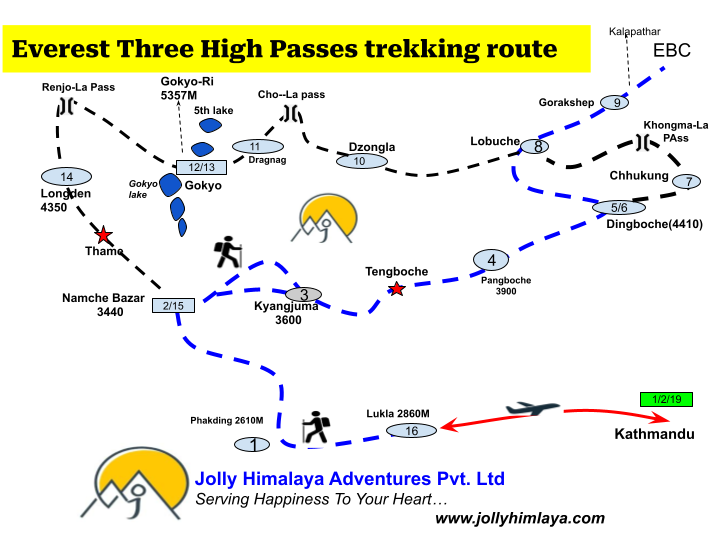
The Everest Three High Passes Trek is a challenging and rewarding adventure that offers a comprehensive exploration of Nepal’s Khumbu region. It is designed for experienced trekkers seeking an immersive journey through high-altitude passes, breathtaking landscapes, and rich cultural heritage. The trek involves crossing three major passes: Kongma La (5,535 m), Cho La (5,420 m), and Renjo La (5,360 m). Kongma La, the highest of the three, provides spectacular views of Everest, Lhotse, Makalu, and Ama Dablam, requiring steep ascents and glacier crossings. Cho La connects the Everest Base Camp route with the Gokyo Valley, offering technical challenges and stunning vistas of the surrounding peaks. Renjo La is celebrated for its solitude and panoramic views of the turquoise Gokyo Lakes and the Himalayas.
The trek include visits to iconic landmarks such as Everest Base Camp, Kala Patthar, and Gokyo Ri, each offering unique perspectives of the world’s highest peaks. The trail passes through vibrant Sherpa villages like Namche Bazaar, Dingboche, and Thame, allowing trekkers to experience the local culture, ancient monasteries, and Buddhist traditions. The journey also traverses diverse landscapes, ranging from lush rhododendron forests and rugged glacial moraines to high-altitude tundra and icy pathways.
This trek is rated as one of the most demanding in the Everest region, requiring a high level of physical fitness and prior trekking experience. Trekkers can expect long hiking days of 6 to 8 hours at high altitudes, with proper acclimatization being crucial to ensure safety and success. The best times to undertake this adventure are during the spring (March to May) and autumn (September to November), when the weather is stable, and visibility is at its best.
The Everest Three High Passes Trek is perfect for those who seek to push their limits while immersing themselves in the grandeur of the Himalayas and the unique culture of the Everest region.
Day 1: Arrival Experience in Kathmandu, 1350 m.
Day 2: Preparation day at Kathmandu, 1350 m.
Day 3: Flight to Lukla (2,800m) and Trek to Phakding, 2610 m.
Day 4: Trek to Namche Bazaar, 3440 m.
Day 5: Acclimatization Day - Trek to Kyangjuma Village, 3600 m.
Day 6: Trek to Pangboche through Tengboche, 3900 m.
Day 7: Trek to Dingboche, 4410 m.
Day 8: Acclimatization Day in Dingboche- Hiking day, 5100 m.
Day 9: trek to Chhukung, 4730 m.
Day 10: Cross Kongma La Pass (5,535 m) and Trek to Lobuche, 5535 m.
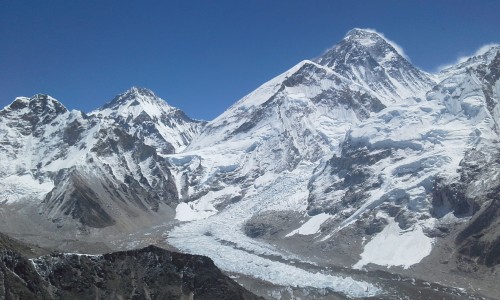
Day 11: Trek to Everest Base Camp (5,364 m) and Return to Gorak Shep, 5160 m.
Day 12: Hike to Kala Patthar (5,545 m) and Trek to Dzongla, 4830 m.
Day 13: Cross Cho La Pass (5,420 m) and Trek to Dragnag/Thangnak, 4700 m.
Day 14: Trek to Gokyo, 4790 m.
Day 15: Acclimatization and Hike to Gokyo Ri, 5357 m.
Day 16: Cross Renjo La Pass (5,360 m) and Trek to Lungden (4,380 m), 4380 m.
Day 17: Trek to Lungden from Namche Bazar, 3440 m.
Day 18: Trek to Lukla, 2860 m.
Day 19: Fly to Kathmandu or Ramechhap (if), 1350 m.
Day 20: Fly back home
After arriving at TIA Airport Kathmandu, you must take an arrival visa from the immigration of Nepal for your stay in Nepal. However (15,30,90days), if you want to spend time in Nepal, you must pay ($30 for 15 days, 50 for 30 days). We also want to inform you that you may take up to 3 hours to complete all the procedures. It may vary according to the schedule of the plane and flight that you are coming from.
After that, we will stand at the arrival point with our banner and nameplate and take you to your hotel in the vehicle we have arranged. In this order, you will be welcomed with flowers and Khada (Special Buddhist prayer things). With all that, on the way to the hotel, you will find Nepali traffic jams, which can irritate you, but still, you will explore a little bit of the capital city of Nepal.
We will have a pre-trek briefing about the trek and the upcoming mountain adventure. Our representative members will give you thorough information about the details of journey, like flights from Kathmandu to Lukla, the teahouse accommodation, Everest Three Passes route, water facilities in the mountains, and details about trekking in Nepal with your various queries.
In the evening, a special welcome dinner at a traditional Nepali restaurant is accompanied by a cultural performance showcasing local music and dance. You'll also be introduced to your trekking guide for your Everest Three High Passes Trek during the dinner.
Take an early morning scenic flight to Lukla, the gateway to the Khumbu region. Begin your trek with a gentle hike through villages and lush forests, reaching Phakding in about 3-4 hours.
Cross suspension bridges over the Dudh Koshi River and enter Sagarmatha National Park. A challenging uphill section leads to Namche Bazaar, the vibrant Sherpa town, after a 6-7 hour trek
As our rest/ acclimatization day we will hike to Everest View hotel where you can explore stunning view of Mt. Everest along with 4th Highest Mt. Lhotse, Mt. Nuptse, Mt. Amadablam and many more peak of Khumbu region. And after the panaromic view we will head down to famous Khumjung Village and proceed down to beautiful and foresty Kyangjuma Village for the night stay. Normally peaple stay in Namche but we recommend to skip that day to make next day easier and different scene of landscape.
Follow the trail through rhododendron forests and small villages to Tengboche. Visit the iconic Tengboche Monastery, surrounded by breathtaking views of Everest, Lhotse, and Ama Dablam. After our lunch at Tengboche village we will proceed to the Pangboche village.
The trek takes about 6-7 hours.
Hike through picturesque landscapes, passing Imja Valley and Pangboche village. Arrive at Dingboche, a scenic village surrounded by vast mountain views, after a 5-6 hour trek.
Take a rest day to adjust to the altitude. Hike to Nagarjun Hill (5,100 m) for acclimatization and panoramic views of Lobuche East, Makalu, and other peaks.
A relatively short trek of about 3-4 hours takes you to Chhukung Valley - lap of Island Peak. Prepare for crossing the Kongma La Pass the following day.
Begin early for the challenging ascent to Kongma La Pass, the highest pass of the trek. Enjoy stunning views before descending to the Khumbu Glacier and reaching Lobuche after 8-10 hours of trekking.
Walk along the Khumbu Glacier to reach Everest Base Camp, a surreal experience surrounded by towering peaks. After exploring the base camp, return to Gorak Shep for the night.
Note: You can hike to Kalapathar same day if you feel comfortable for good sunrise view - If weather is clear ( Optional)
Duration: 8-9hrs (Avg)
Distance; 11.2 Km
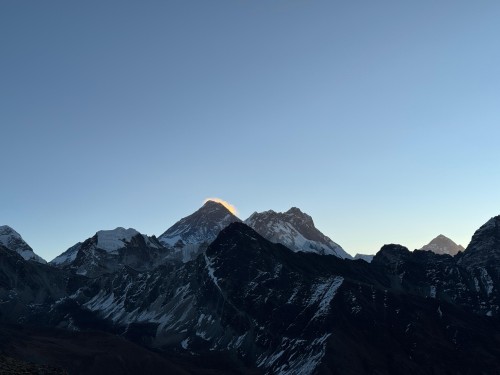
Start early for a sunrise hike to Kala Patthar, offering one of the best views of Everest and neighboring peaks. Descend to Gorak Shep and continue to Dzongla for an overnight stay.
Embark on a challenging trek across Cho La Pass, involving glacial terrain and steep ascents. Descend to Dragnag/Thangnak after a full day of trekking.
Duration: 7-8 Hours (Avg)
Distance: 8.7 Km
A relatively short trek leads to Gokyo, home to the stunning turquoise Gokyo Lakes. Spend the afternoon exploring the lakes or resting.
Climb to Gokyo Ri for panoramic views of Everest, Cho Oyu, Lhotse, and the Gokyo Lakes. Spend the rest of the day relaxing in Gokyo.
Note: You can Hike Gokyo Ri in the day of 14th to make trip one day short
Cross the final high pass, Renjo La, which offers breathtaking views of the Gokyo Lakes and the Himalayas. Descend to the village of Lungden after a long day of trekking.
The journey from Lungden to Namche Bazaar is a long but rewarding day, descending through stunning Himalayan landscapes and traditional Sherpa villages. The trail initially follows a gentle descent along the Bhote Koshi River, passing through picturesque settlements like Thame. Here, you can visit the historic Thame Monastery, an ancient spiritual site with strong ties to Sherpa culture and Buddhism. The trek continues through pine forests and past Mani walls adorned with prayer flags, offering serene views of the surrounding peaks. As you approach Namche Bazaar, the terrain becomes more familiar, and the lively atmosphere of the bustling Sherpa hub signals the end of the day's trek. This descent typically takes around 7-8 hours, combining cultural exploration with breathtaking scenery.
Retrace your steps along the Dudh Koshi River to Lukla. Celebrate the completion of your trek with your team of your memorable trip with Jolly Himalaya Adventures.
On the final day in the Khumbu region, take an early morning flight from Lukla, either to Kathmandu or Ramechhap, depending on the flight schedule and weather conditions. The flight offers breathtaking aerial views of the Himalayan range, including iconic peaks like Everest and Lhotse, as you bid farewell to the rugged landscapes of the Everest region. If flying to Kathmandu, you’ll land in Nepal’s bustling capital, where you can relax and reflect on your trek. Alternatively, if flying to Ramechhap, a short drive (4-5 hours) brings you back to Kathmandu, adding a scenic overland journey through the lush hills and countryside. Regardless of the route, this marks the conclusion of your unforgettable Himalayan adventure.
Note: Sometime you should fly to/from Ramechhap due to Government roule for certain period.
After a beautiful day stay in Kathmandu, you will return home after collecting your beautiful memories, where our staff or we will say goodbye to you uniquely and take you to the airport according to the time of your return ticket.
If bad weather and other natural disasters circumstance makes your trip longer than our estimate itinerary and the cost will be extra!
If bad weather and other natural disasters circumstance makes your trip longer than our estimate itinerary and the cost will be extra!
1. Rules and Fees for Flights to Lukla
Significant adjustments have been made to flight operations for passengers opting to fly to Lukla. The majority of flights to Lukla now depart from Ramechhap Airport due to the increased congestion at Kathmandu's Tribhuvan International Airport. Trekkers must drive to Ramechhap from Kathmandu for four to five hours before taking a plane to Lukla. A round-trip ticket from Ramechhap to Lukla costs about USD 400 per person. Due to the extreme weather, flights to Lukla frequently experience delays or cancellations. Additionally, because of the airport's difficult approach and short runway, pilots flying to Lukla need specific training and certification.
2. New Guidelines for Trekking and Permit Costs
In an effort to better control tourism in the Everest region, Nepal recently updated its rules and fees for trekking permits. The Sagarmatha National Park Entry Permit, which costs NPR 3,000 per person,(1500NPR for SAARC nationals and the Khumbu Pasang Lhamu Rural Municipality Entrance Permit, which varies by nationality, are now essential permits for trekkers. The entrance fee is NPR 2,000 per person for Chinese and SAARC nationals, and NPR 3,000 per person for other foreigners.These fees support local community development, trail upkeep, and environmental conservation. Special exemptions are granted to children under ten years old, diplomats, and VIPs, provided they present valid documentation.
3. Conditions of the Road to Surke (As an Alternative to Lukla Flight)
Reaching Surke by road is an option for people who don't want to fly to Lukla, but it's a difficult and drawn-out trip. The first step for travelers is to drive from Kathmandu to Salleri or Phaplu, which takes about eight to ten hours on winding, mountainous roads. Trekkers must walk through numerous villages and rocky paths for two to three days to get to Surke from Salleri or Phaplu. Road conditions can be erratic, particularly during the monsoon season when muddy roads and landslides can seriously slow down traffic.
4. Trekking's Best Seasons
The pre-monsoon (March–May) and post-monsoon (October–November) seasons are the best times to trek to Everest Base Camp. The ideal times of year for trekking are when there is steady weather, clear skies, and moderate temperatures. Trekkers should plan ahead for flights, permits, and lodging because the trails are at their busiest during these months. While the monsoon season (June to September) brings heavy rain, landslides, and poor visibility, making trekking more challenging, winter (December to February) can be extremely cold with heavy snowfall.
5.Travel Insurance & Emergency Evacuation
Trekking to Everest Base Camp carries risks, including altitude sickness, injuries, and unpredictable weather conditions. As a result, comprehensive travel insurance is highly recommended. Insurance should cover high-altitude trekking, medical emergencies, and helicopter evacuation, as the cost of a helicopter rescue from the Everest region can exceed USD 5,000. Trekkers should verify their insurance policy before departing to ensure they are covered for potential emergencies.


The Everest Three High Passes Trek is a challenging trek in Nepal’s Khumbu region, crossing three high-altitude passes—Kongma La (5,535 m), Cho La (5,420 m), and Renjo La (5,360 m). It includes visits to Everest Base Camp, Kala Patthar, and Gokyo Lakes, offering breathtaking mountain scenery and cultural experiences.
This trek is considered very challenging due to its high altitude, long trekking days (6-9 hours daily), steep ascents and descents, and extreme weather conditions. It is suitable for experienced trekkers with high fitness levels.
The standard itinerary takes 18-21 days, including acclimatization days. The duration may vary depending on pace, side trips, and weather conditions.
The best seasons are:
Yes, prior high-altitude trekking experience is highly recommended due to the trek’s difficulty. Beginners should gain experience with moderate treks before attempting the Three High Passes.
The trek starts in Lukla, accessible by a 30-minute flight from Kathmandu or Ramechhap (Manthali Airport). Ramechhap flights are common during peak seasons due to congestion at Kathmandu’s airport.
Yes, you can customize the itinerary of the Everest Three High Passes Trek based on your preferences, fitness level, and time constraints. Trekking agencies and independent guides can tailor the route to suit your needs.
Feel free to contact us customize the itinrary for you.
Accommodation consists of teahouses and lodges, offering basic but comfortable rooms. In high-altitude areas, facilities are limited, with shared bathrooms and simple meals.
Teahouses provide meals such as:
Yes, but with limitations. Wi-Fi is available at some teahouses for a fee. Charging electronics is also possible, but it may cost extra, especially at higher altitudes. A power bank and solar charger are recommended.
Essentials include:
Yes, travel insurance is mandatory and must cover:
Temperatures vary by season and altitude:
The Three High Passes Trek is for those seeking a more adventurous, off-the-beaten-path experience with fewer crowds, more diverse landscapes, and superior panoramic views compared to the classic Everest Base Camp trek. However, it is more challenging and requires better fitness and preparation.

15 Days From $ 1000
14 Days From $ 750

14 Days From $ 2400

5 Days From $ 4200

17 Days

13 Days From $ 1000

20 Days From $ 1750
.jpg)
14 Days From $ 5500

3 Days From $ 250

20 Days

18 Days From $ 2250
© 2023 - 2026 All rights reserved. Jolly Himalaya Developed By : Xenatech Nepal
 20 Days
 Hotel
Hotel
 Meals
Meals Breakfast